Pole Barn Electrical Rough-In in Lubbock, TX
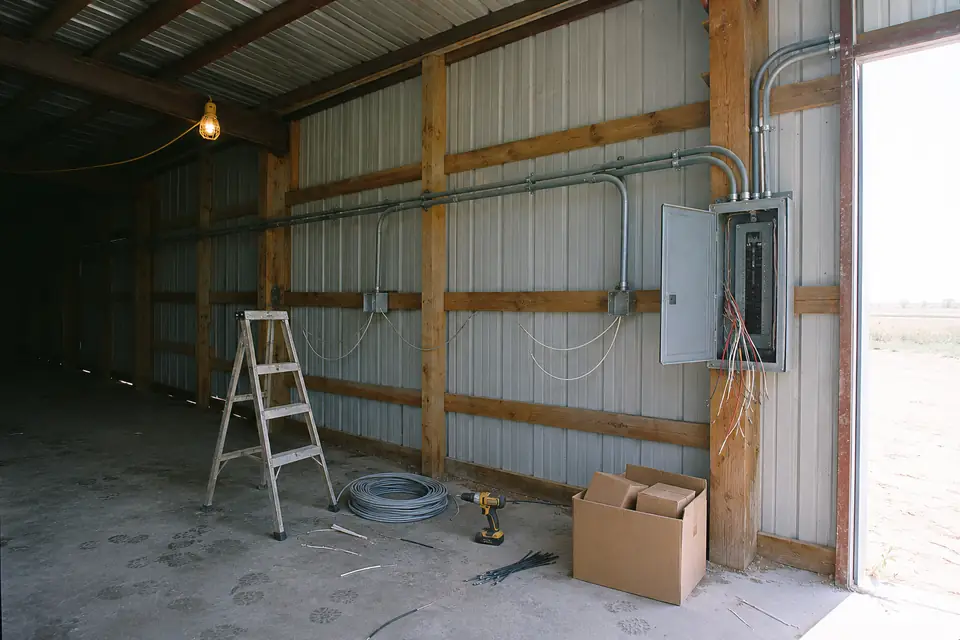
Our pole barn electrical rough-in in Lubbock happens while the frame is still open. Every run is reachable then. Nothing is reachable once the liner goes on. Give Pole Barn Builders Lubbock TX the full equipment list before the panel gets sized. Lights, outlets, a compressor, a welder, heaters or air conditioning, a well pump, an EV charger. And the tools you have not bought yet.
The city enforces the 2020 National Electrical Code with local amendments, in force since June 2024. A licensed electrician does the wiring wherever you build. We sequence that trade against the steel, not after it. Where the building sits moves the quote as much as the tool list does. A barn out across a yard needs a feeder route of its own. A shop beside the house usually does not. Send the equipment list and the distance from your existing service. We will come back with what the electrician needs from us.
Get a quote on your building
How We Handle Pole Barn Electrical Rough-In in Lubbock
List everything the building will run: lights, outlets, a compressor, a welder, heaters or air conditioning, a well pump, EV charging. Add the equipment you have not bought yet. That list is what sizes the service and the panel. We would rather hand a long one to the electrician now. The other way is paying us to cut capacity into finished walls in two years.
Distance drives the feeder. A building sitting well off the house or the utility pole needs a trench. The length of that run changes the cable size. We settle the route with you before the pad is cut. Our trench stays clear of the drive.
Decisions that are cheap while the frame is open
- Panel location
Put the panel where you can reach it and where a vehicle cannot back into it. Leave working clearance in front. We block the posts for it before our steel goes on.
- Conduit or cable
Conduit protects wiring in a shop or a farm building and makes the next change easy. Walls left unfinished usually get it. Surface runs on the posts and girts also stay visible for the inspection.
- Outlet and light layout
We would rather put outlets where you actually work than space them to a rule. Mark the benches, the tools, the work zones for us. The circuits can follow them.
- Exterior lights and outlets
Weather-rated fixtures and receptacles earn their cost out here. Wind-driven dust gets into anything that is not gasketed, and March through May moves plenty of it.
What has to be standing before we pull a wire
- Step 01Roof on
Rough wiring waits for a dry building. We will not leave boxes and cable out under a sky that averages 30 to 50 thunderstorm days a year. Most of those fall April through June.
- Step 02Girts and blocking located
Conduit, boxes, the panel: all of it needs something solid to land on. Blocking goes in while we are still framing. No electrician should turn up and find nothing behind the panel location.
- Step 03Anything under the slab committed
A floor outlet, a conduit crossing the floor or a feeder coming up inside the footprint has to be set before the pour. None of that gets added later without a saw and a patch. We would rather hear about a floor drop now.
- Step 04Rough-in, then inspection, then cover
Our insulation and liner panels wait on the inspection. Never the other way round. A failed rough-in with the walls already closed parks the whole schedule.
What each kind of building usually needs
| Building | Typical circuits | Often forgotten |
|---|---|---|
| Storage shed | Lighting and a few outlets | An outdoor receptacle and a circuit for a door opener |
| Workshop | 240-volt tool circuits, outlets along the walls, lighting | A dedicated compressor circuit and a welder receptacle |
| Barn with animals | Wet-location lighting, GFCI outlets, fans | Circuits for heated waterers in a freeze |
| Barndominium | Full residential wiring plus shop circuits | Separate panels for house and shop |
What the inspector is actually looking at
We call for the rough-in while the walls are still open. An inspector can only sign off on what is visible. Anything we close early gets reopened.
- Runs still visible
Conduit, cable, boxes, splices: all of it has to be in and uncovered. Insulation or a liner panel over any of it turns a ten-minute look into a demolition job. Ours stays off until the sign-off is in hand.
- Boxes set and supported
Box depth, box fill, fastening all get looked at. Surface runs on posts and girts get checked for support spacing. Open framing puts every one of those in plain sight. We would far rather have a correction called from the floor than found behind a liner.
- Grounding and bonding
The grounding electrode, the bonding at the panel and the equipment grounds all come under the 2020 code the city has adopted. An electrician gets those right or gets a correction notice. Neither outcome is negotiable on site.
- Working clearance at the panel
We block for the panel where a vehicle cannot back into it. The clear space in front is a code dimension. Not a courtesy. That clearance has to survive the shelving you put up two years later.
Licensing, inspection and the utility
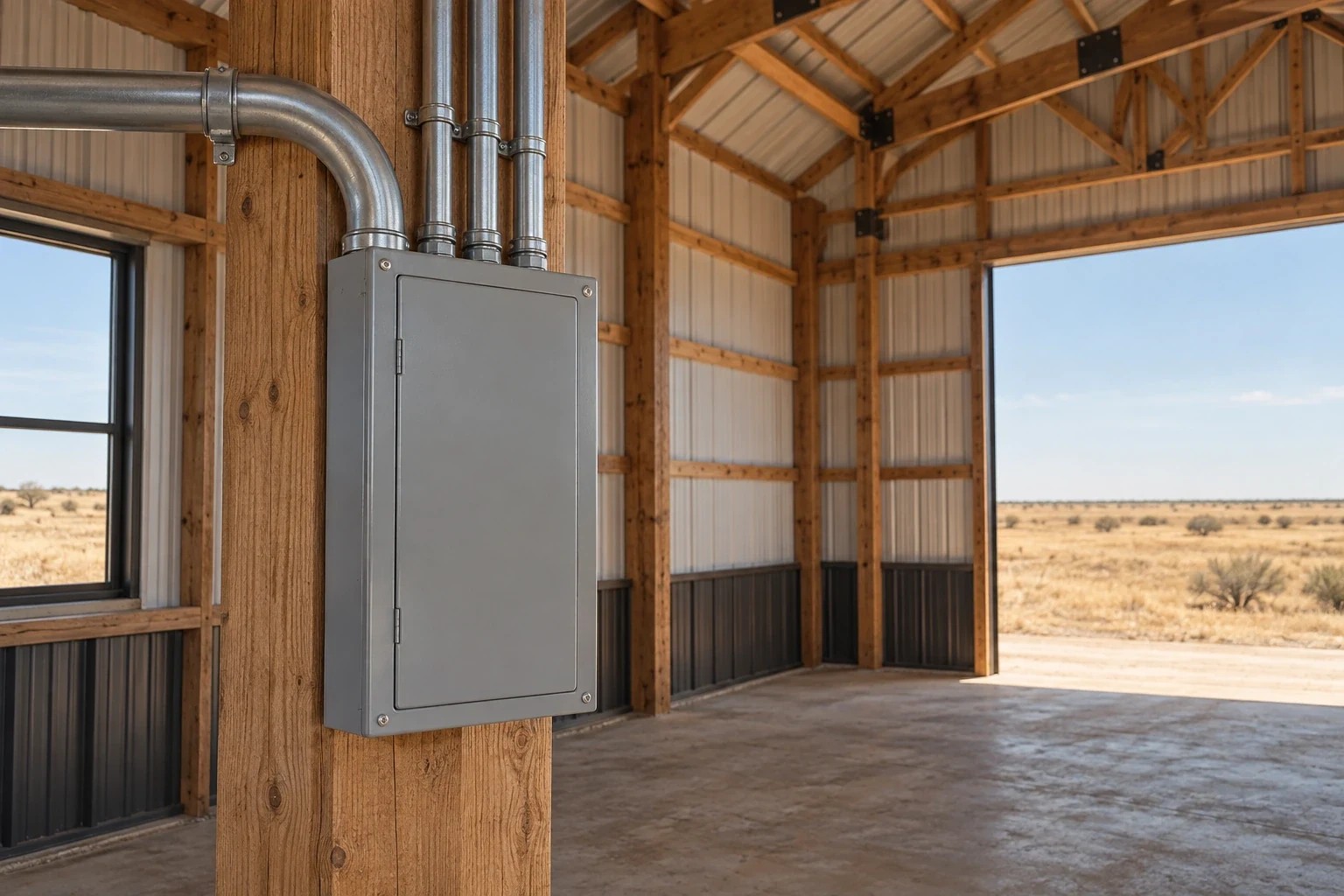
Electrical work in Texas belongs to a licensed electrician. Rough wiring is normally inspected before anything covers it. Whether that runs through a city permit or through the unincorporated county depends on where your site sits. We confirm which authority has jurisdiction before we schedule the trade.
We put the utility request in early. The power company decides where the service attaches and what poles or transformers it needs. It also decides how long that takes. None of it moves faster because we asked late.
Getting power across a farmyard
Out on irrigated ground the service route has a machine driving over it. Around 80 percent of irrigated acreage on the High Plains runs on center pivot. Roughly 87 percent of that is low-pressure, with drop tubes hanging below the span. That puts the lowest moving part under truss height. We walk the pivot path with you before anything overhead gets planned. The feeder, the meter, the yard lights all stay out from under it.
Underground has its own arguments out here. Caliche starts somewhere around thirty to sixty inches down and goes near rock-hard with depth. A trench deep enough for a feeder is real work. We would rather open that ground once and drop the water line in the same cut. Low ground near a playa holds a wide sheet of water after heavy rain. Our route goes around it, not through it.
Questions we get about wiring a barn
Can I wire my own pole barn?
Rules on that vary by jurisdiction. Even where an owner can do the work it still has to meet code and pass inspection. We would rather you used a licensed electrician. A failed rough-in inspection parks the rest of our schedule.
How much service does a shop need?
Your tool list sets it. A shop running a welder and a compressor often lands somewhere in the 100 to 200 amp range. The electrician sizes it off the equipment, not off the square footage.
Is conduit required?
Depends on the wiring method and the code in force where you build. Conduit is common in barns and shops. The walls stay open, the runs stay reachable, and a dropped board does not take a cable with it.
How do I get power out to a remote barn?
Trenched feeder or overhead from the utility, and distance drives the cost either way. We sequence our trench with the pad and the drive so the same ground is not opened twice.
Do I need GFCI protection in a barn?
The electrical code calls for ground-fault protection on a lot of outlets in garages and outbuildings. The same goes for damp locations. The electrician applies whatever is in force where you build.
Can solar be added to a pole barn roof?
Mention it and we put it in front of the engineer at the design stage. The frame has to carry the load. A steel roof takes rail or clamp-on mounts that want blocking in the right places. Adding it to a finished roof is possible and costs more than allowing for it now.
Who is the best company for pole barn electrical rough-in in Lubbock, TX?
Ask how the framing and the wiring get coordinated, since money leaks out of that gap. We take your equipment list before the panel gets sized. The posts and girts get blocked for the panel and the conduit while the frame is still open. We confirm which authority has jurisdiction, so the rough-in inspection happens before anything covers the runs. Licensed electricians do the wiring. Put the same questions to anyone else quoting the building and compare the answers. Our quotes and site visits are chargeable, and you will hear the figure first.
Got an equipment list?
Send it over with the building location. We will tell you what the electrician needs from us and what we need from you.