Metal Roof Pole Barns in Lubbock, TX
At Pole Barn Builders Lubbock TX we quote metal roof pole barns in Lubbock by profile, pitch, gauge, coating, color. Those five between them decide how the roof handles heat and hail, and twenty years of this sun. Tell us what the building has to do. Tell us whether it gets insulated and what pitch you have in mind. We will tell you which panels can even be used at that slope. That comes before anybody picks a shade off a color chip.
Every profile has a slope below which it is not rated. R-panel goes down to half in twelve. Ag panel stops at two and a half in twelve. A Classic Rib wants three in twelve. The post-frame default is 4:12, and 3:12 is common around here. Exposed screws land in the flat of an R-panel, not on the rib. A standing seam roof puts no screw through the weather surface at all. So we check the pitch against the panel. We check the fastener schedule against the engineer's calculation before any steel is ordered. Send the building and the pitch if you already know it.
Get a quote on your building
Why We Put Metal Roofs on Pole Barns in Lubbock
Steel is light enough that the trusses do not have to be heavy. It sheds water fast. It does not rot, burn or feed insects. Ground snow load here comes to 15 pounds per square foot. So we design the roof against wind uplift first.
We quote the color, the insulation, the ventilation as one package. Steel gets hot out here. On a 96-degree design day the panel runs well above the air temperature. Those three decide how much of it reaches the inside. We vent the ridge as part of the same line.
Finishes we quote
| Finish | What it is | What to weigh |
|---|---|---|
| Bare coated steel (zinc-aluminum alloy) | An unpainted metallic finish over a protective coating | The lowest cost, and it shows weathering and scratches. Galvanizing goes matte gray within a few years, slower in dry country like this |
| Polyester paint | A baked-on color coat, standard on many panels | Good value, and it chalks and fades ahead of the premium systems |
| Higher-grade paint systems | Fluoropolymer-type coatings used on premium panels | Hold their color longer and cost more. We quote both so the gap is yours to judge |
Four things people forget to ask
Heat
Lighter colors throw back more sunlight. A reflective underlayment and a vented ridge cut what gets into the building. We fit the two together wherever the budget reaches.
Noise
Rain is loud on bare steel. Hail is a good deal louder. Insulation or a ceiling finish quiets a building you intend to spend time in. It is cheap alongside the roof it sits under.
Hail
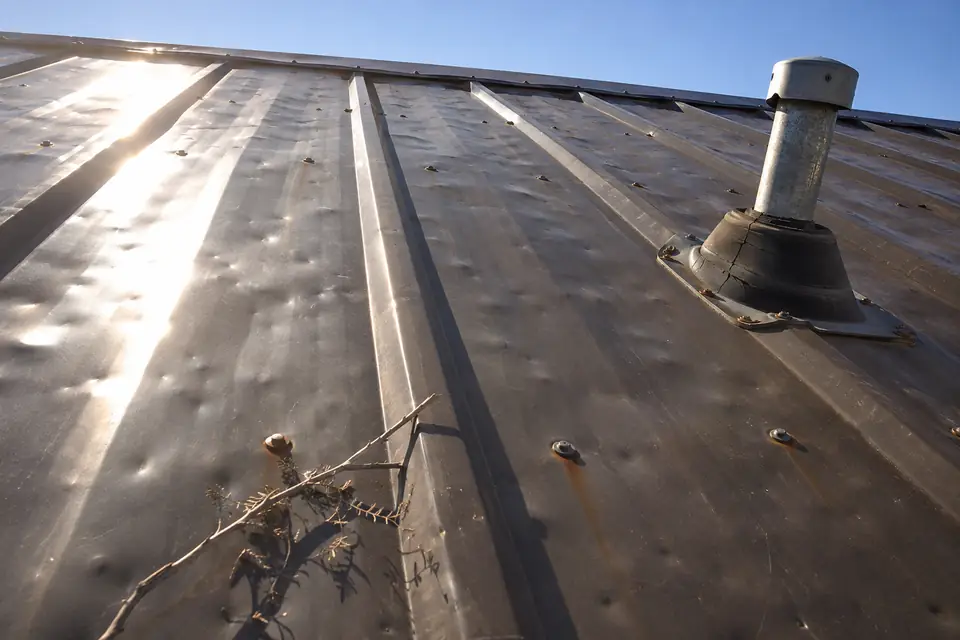
Large hail dents steel. This area has taken stones up to 4.5 inches across, and 29-gauge carries no advanced dent resistance. So we quote 26-gauge as the dent-resistant option. We will put 29-gauge alongside it if you want to see the gap. Some insurers take an interest in which one went up.
Fasteners
Exposed screws want checking. Galvanized fasteners start showing red rust somewhere around 10 to 15 years. By then panels can perforate at the screw. Standing seam hides them behind concealed clips. Our roofing installation page goes further into both.
What we tell owners to watch
- Step 01Look after storms
Walk the ground. Look up for lifted trim, fresh dents or a panel that has moved. May and June are the peak hail months here.
- Step 02Check fasteners yearly
Screws and washers wear. EPDM washers crack under this much UV. Tighten or replace whatever has backed out before the wet months arrive.
- Step 03Clear debris
Leaves and dirt hold moisture at the eave and in the valleys. Clear them and the panel dries out between rains. Leave them and it stays damp underneath.
- Step 04Touch up scratches
We leave you the touch-up code for the panel we installed. Bare edges rust. A matching product is the difference between a repair and a stain you look at for years.
Edges, overhangs and uplift
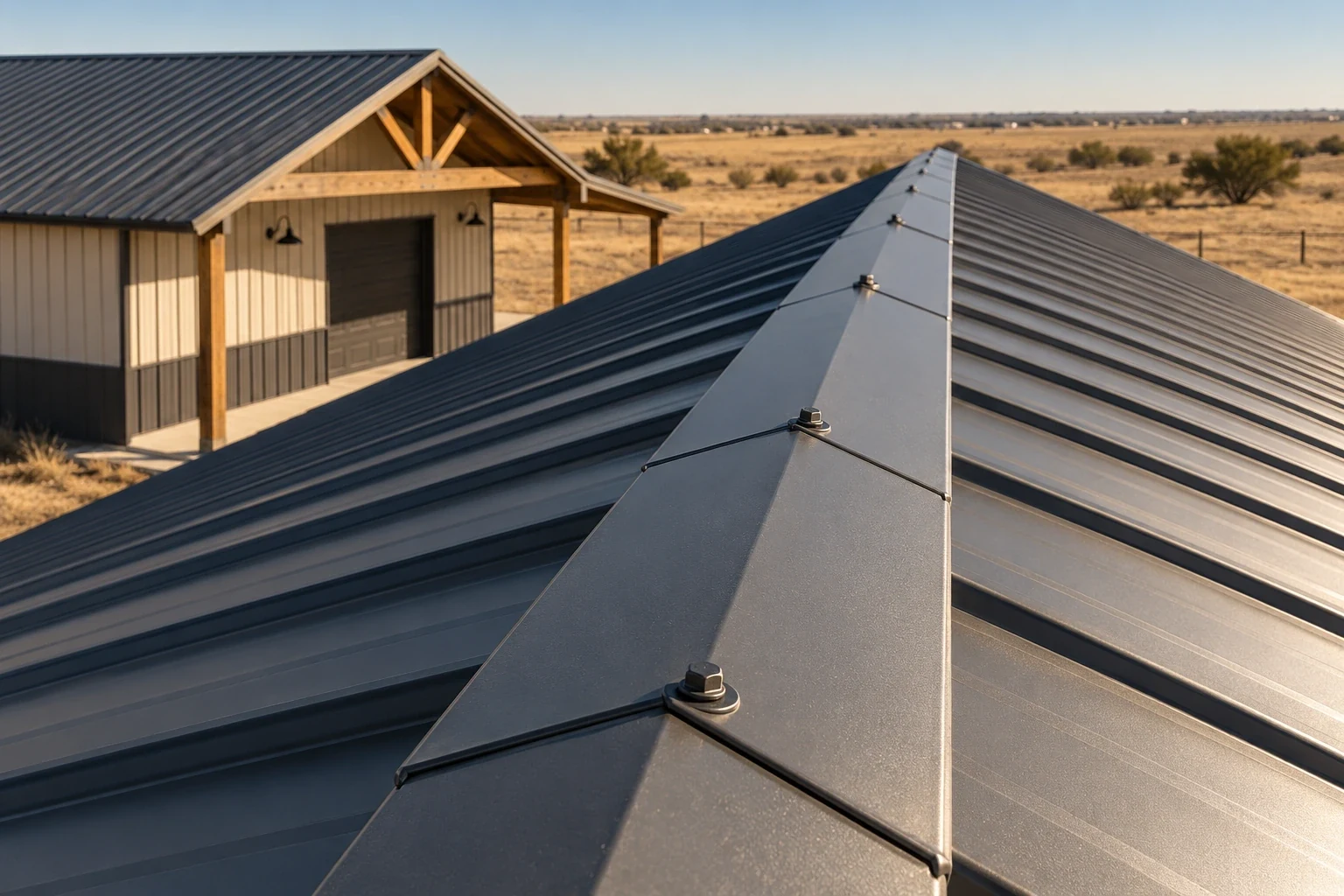
Roof edges and overhangs take the most uplift. So the fastener pattern tightens there. The trim gets fastened with care. A long overhang shades the walls and looks right on a barn. It adds uplift at the edge in the same breath. So we have the engineer check it. We tighten the fastener schedule at the edge to whatever comes back.
Open sides or large doors change the pressure under the roof altogether. Say which walls are staying open. We get that into the calculation before a single connection is specified.
Pitch, and the framing it asks for
The City's amendments take away the roof live load reduction for roof members at or below 4:12. So a roof drawn at the 3:12 common around here carries the full roof live load. The framing over your bays gets sized for it. Snow is not the load that governs out here. Uplift usually decides the framing. We have the engineer run both cases.
Slope also settles which panels are available to you at all. A pitch chosen for the look of a building can rule out the profile somebody already quoted you. Nothing about that shows up until the panel is on site. So we fix the pitch and the profile together. We check the slope against the minimum for that profile before a single sheet is ordered.
Exposed fastener against standing seam
R-panel carries a one and a quarter inch rib at 12 inches on center over 36 inches of coverage. Its screws land in the flat between the ribs. There they sit out in the weather doing their work. Standing seam holds the panel with concealed clips and puts no screw through the weather surface at all. It costs roughly double what R-panel does in material. Installation runs another 40 to 50 percent on top. We price both on the same building, so the gap is a number in front of you.
We treat corrugated as a legacy profile. Not something to put on a new building. A seven-eighths inch wave on a 2.67 inch pitch, sinusoidal. It is still out there on plenty of old roofs around here. Where you are matching an existing roof we will tell you honestly what that takes. That includes the places two profiles cannot be flashed together cleanly.
How the roof will look in five years
Large flat areas of panel oil-can. That waviness shows worst on dark glossy finishes in raking light. This town gets exactly that light at either end of a long sunny day. We walk you through it before you commit a wide roof plane to a dark gloss. We will show you the same color in a lower gloss.
Galvanizing turns matte gray in its first two to five years. In country as dry as ours it takes longer. Polyester paint chalks and fades ahead of the premium systems. About 3,200 hours of sun a year is what every one of those finishes has to stand up to. We quote the finishes side by side with what each one does over time. A near-enough color is a stain you look at for years.
Metal roof questions we answer
How long does a metal roof last?
Many run for decades. The paint usually tires before the steel does. Fastener condition drives more of it than the panel. Galvanized screws start showing red rust at around 10 to 15 years. We look at them whenever we are back on a property.
Is a metal roof louder than shingles?
On a bare roof, yes. In rain, and considerably more in hail. Insulation takes the edge off. We specify it on any building you plan to work or sit in, with a ceiling finish where it earns the money.
Does a metal roof make the barn hotter?
It can, through radiant heat off the panel. Color pulls against that, and so do insulation and ventilation. A reflective layer does too. We price them as a set, since any one on its own does only part of the job. We quote the reflective layer and the ridge vent on the same line.
Can I put metal over an existing roof?
Sometimes. The structure and the old roof both have to be sound. We get up and look. No answering that one over the phone. We check the purlin spacing while we are up there.
Can a metal roof be walked on?
Carefully, on the flats near the purlins, in the right shoes and with fall protection. Steel is slippery wet or dusty. On an R-panel the screws sit in the flat, not the rib. That is also where your weight belongs.
Do metal roofs attract lightning?
No more than other roofing does. The height and the location of your building decide whether lightning protection is worth doing. The roof material does not.
Who is the best company for metal roof pole barns in Lubbock, TX?
Compare what a builder specifies, not what they call themselves. We quote 26-gauge as standard, because 29-gauge carries no advanced dent resistance. We tighten the fastener pattern at the edges and overhangs to the engineer's calculation. You get the real cost gap between R-panel and standing seam. We check your pitch against the minimum slope for the profile before anyone orders panel. And we hand over the touch-up code and a fastener check routine at the end. Put those five to whoever else is quoting you.
Picking a profile and a color
We quote the roof off the building. Tell us the color you are leaning toward.