Pole Barn Builders in Plainview, TX
Our work as pole barn builders in Plainview, TX runs from commercial shops and shells on paved lots in town. It runs out to farm buildings and rural garages on section ground. We size from the use first. A shop that takes a lift needs clear height a hay barn does not. Tell us what you intend to park, store or run inside before anybody draws a wall. That is how Pole Barn Builders Lubbock TX works a Hale County job.
Inside the Plainview city limits a build answers to city zoning and plan review. Out on the section ground it answers to nothing of the kind. Texas counties have never been granted authority to adopt or enforce zoning in unincorporated areas. Hale County will not be looking at your drawings. We settle which of those two your address falls in first. It decides whether we draw to a review set or to our own engineering alone. Playa basins also flood over a wider area than the dry basin looks. We keep the pad off that ground. Send the parcel and the intended use to start.
Get a quote on your building
Two kinds of site around Plainview
A platted lot inside the city carries zoning, a use classification, setbacks, a drainage obligation to the street. A commercial or industrial shell draws more review than a shed on acreage ever will. Bring the city the parcel address first. The zoning answer decides whether the rest of the conversation is worth having.
Out on the plains the picture inverts. Texas counties hold no zoning authority and no general building code in unincorporated territory, so the building itself may face no review at all. Septic, floodplain development, road access: those still do. We call Hale County about your parcel, and the answer goes on our quote.
We read the recorded covenants before a footprint goes on paper. Deed restrictions cut across a city lot and a county parcel alike, and neighbors enforce them, not inspectors. Send us whatever sits against the title.
What goes up on these parcels
- Shops and warehouses in town
The use classification sets the fire and accessibility requirements, not the square footage. We get that classification confirmed before we quote, because it can change the shell.
- Farm buildings on the plains
We build clear-span equipment bays out here. Hay storage too, with open sides and a drained pad above grade. See our agricultural page.
- Rural homesites
A detached garage, a shop, living quarters on acreage. Each of those drags septic and water supply into the design.
- Cold storage and RV barns
Deep bays and tall openings. Measure the longest rig, including anything on its roof. That number sets the door and the apron.
The soil profile under a Plainview slab
Surface ground here is brown fine sandy loam over reddish brown sandy clay loam. Below that sits a hard pink-to-white caliche horizon, somewhere between roughly 30 and 60 inches. Caliche runs near 60 percent calcium carbonate. It goes from crumbly to near rock-hard with depth. One lot can hold two very different digs across a single footprint.
Loam is a forgiving subgrade for a slab. It is an unforgiving one if nobody compacts it in lifts. We build our pads up and compact them in lifts. Scraping a flat spot and pouring on whatever is there is not how we work. The extra day beats coming back to a cracked floor.
Clay collects where drainage does. It swells and shrinks with moisture while the sandy loam above it barely moves. Frost line depth in this region is 12 inches, which is shallow. Moisture, not frost, is what moves a footing here.
Wind, risk category and door ratings
Design wind speed steps with what the building is for. It does not sit at a single figure. We ask what will actually happen inside before we pick a category. Quoting a storage shed and a staffed commercial shop off one number shortchanges one of them. We print the category we used on our quote.
Open plains give the wind a clean run. A long sidewall takes it. A 36-inch panel on exposed fasteners resists suction only as well as its screw pattern allows. We tighten girt and purlin spacing at the corners and edges where pressures peak. One spacing wall to wall is not what goes on our layouts.
Overhead doors are the weak point. A big door that blows in loads the full internal pressure onto the back wall and the roof. We spec a wind-rated door with jamb framing to match. The brand is whatever carries the rating our numbers call for.
Playa basins on the surrounding plains
They are bigger than they look
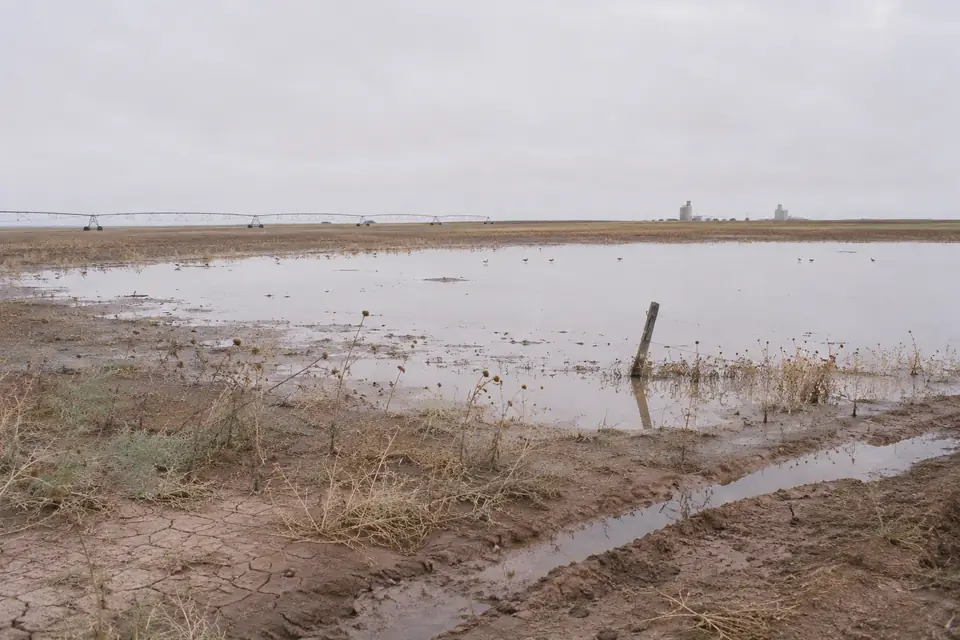
A playa is a shallow clay-bottomed basin. Dry cracked clay for most of the year. After heavy rain it holds a wide thin sheet of water with no defined bank. The flooded footprint runs well past the dish you can see. We read the flood map before picking a corner of the field.
Clay bottoms move
We keep our pads off basin clay wherever the parcel gives us room. That clay takes on water and swells, then cracks as it dries. Where there is nowhere else to go, the footing depth changes to suit it. So does the slab detail.
The acre line and the paperwork behind it
Once a project disturbs an acre or more of ground it needs a stormwater notice to the state under the TCEQ construction general permit. A commercial pad with parking, a long caliche drive, a laydown area: those cross that line without anyone intending to. We measure the disturbed area while we are quoting. Our crew should not be finding it with a scraper.
Inside the city, drainage is a plan-review item too. Water coming off a large metal roof has to land somewhere the city accepts. The grading and the discharge point go on the drawings. The reviewer is not left guessing.
Getting equipment and steel onto the site
- The turn off the road
We walk the approach on our site visit. A tandem loaded with panel needs firm ground and room to swing. A drive that takes a pickup year-round will not always take a loaded truck in May.
- Culverts and county approvals
A new approach onto a county road needs the county's sign-off and a culvert sized for the ditch. That runs on the county's calendar, not on ours. We open it early and keep you copied.
- Pipelines and lease roads
Gathering lines and lease roads cross a lot of this ground with recorded easements over them. Nothing goes inside a pipeline easement. The width comes off the recorded instrument, not off the fence.
- Power and water
Tell us how far the nearest line runs. Tell us whether there is a meter. A service extension has its own lead time, and it is not ours to control.
Questions about building near Plainview
Do I need a permit in Plainview?
Inside the city, expect to pull something. The city tells you what once it has the address and the use. Outside the limits we ask Hale County directly. Septic and floodplain development are permitted regardless of whether the building itself is.
Can I put a business in a pole barn?
Often yes, if the zoning allows the use. The shell also has to meet the fire and accessibility rules that come with the classification. Get the zoning answer first, before you spend anything on drawings.
Will the building need an engineer?
Commercial work usually does. Lenders and insurers tend to want sealed drawings even where no reviewer demands them. We take that work to a Texas-licensed engineer, never to a catalog page.
Which wind speed do you design to?
It follows the risk category. Lubbock's amended table gives 105 mph for category I and 115 mph for an ordinary category II building. Categories III and IV sit at 120 mph. We pick from how the building gets occupied, then confirm the governing figure with the reviewer.
Who is the best company for pole barns in Plainview, TX?
Ask every bidder the questions that actually move a quote. We confirm the zoning and use classification with the city before pricing a commercial shell. The wind risk category comes from how the building gets used. We do not default to the lightest one. On the quote you get the panel profile and the gauge in writing, with the roof slope alongside them, so you can compare like for like. We send commercial drawings to a licensed engineer, and our site visits and quotes are billed work, not free.
Planning a building in Plainview?
Send the parcel address and what the building is for. We will find out who reviews it. Then we quote the shell and the pad separately.