Pole Barn Builders in Petersburg, TX
We work as pole barn builders in Petersburg, TX on open Hale County cotton and grain ground. Equipment sheds, hay barns, livestock shelter, shops. A footprint comes out of the longest implement that has to clear the door. It comes out of the room you need to turn that implement inside, and out of what the ground under the posts will carry. Send us the machinery before you settle on dimensions. Pole Barn Builders Lubbock TX draws it from that, not from a stock plan.
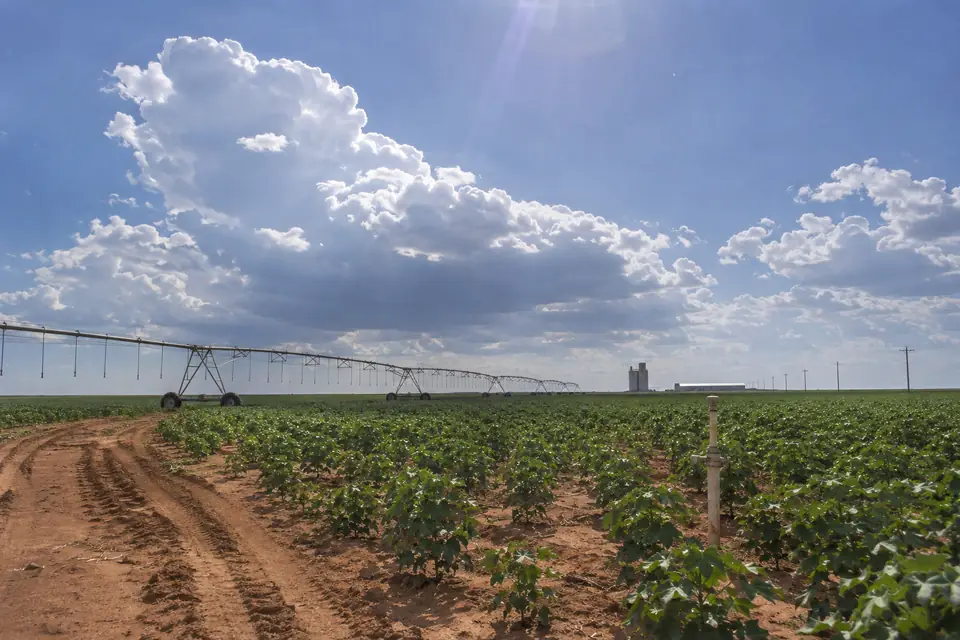
Petersburg sits in Hale County. The City of Lubbock's adopted load table is not what your build answers to. We confirm with the county and the city before we quote. Much of the ground here is irrigated. About 80 percent of irrigated acreage on the High Plains runs on center pivot. We ask where the pivot swings before staking a pad. Caliche can begin anywhere from roughly thirty to sixty inches down. We auger the post holes before anybody quotes a depth. Tell us the address and what goes inside, and we will price it from there.
Get a quote on your building
Petersburg answers to Hale County, not Lubbock County
Hale County holds the road authority and the floodplain administration here. We confirm what Hale County asks of your parcel. A Lubbock answer does not carry over. Texas counties have never been granted authority to adopt zoning or a general building code in unincorporated territory. That shortens the list without emptying it.
Inside the city limits, setbacks are the city's call. So is whether a detached building needs a permit. Call them with the parcel address before the footprint is fixed. Move a sidewall off a side-yard line once the steel is cut and that is a change order.
Septic and floodplain development get regulated whether or not a building permit exists. So does a new approach onto a county road. A recorded deed restriction binds you either way. We pull those threads while we quote.
Disturb an acre or more and the job needs a stormwater notice to the state under the TCEQ construction general permit. Drives, borrow areas, a generous pad: those reach an acre sooner than most owners expect. We tell you when the graded area is close to that line. We tell you what the notice involves.
The ground under a Petersburg pad
Augering a post hole here goes through brown fine sandy loam, then reddish brown sandy clay loam, then a yellowish red layer. Somewhere between roughly 30 and 60 inches it reaches caliche. We drill a test hole before we price footings.
Caliche is a calcic horizon running around 60 percent calcium carbonate. Whitish to tan, crumbly where it starts, near rock-hard deeper in. Shallow caliche means excellent bearing and slow digging. Deep caliche means easy digging and an embedment sized for the softer material above it.
Clay turns up where drainage collects. It swells and shrinks with moisture in a way the sandy loam does not. A footing sized for loam is the wrong footing in clay. The depth comes from what your hole actually shows.
Playa basins and where the pad goes
Thousands of shallow clay-bottomed basins sit in South Plains farmland. Around Petersburg they spend most of the year as dry cracked clay. After a heavy rain they hold a wide thin sheet of water with no defined bank. The flooded area reaches well past the dish you can see from the turnrow.
Walk the ground after a storm. Mark where water stood and how long it took to leave. Give us that before we stake a pad.
We grade against one hard hour. Not the annual total. Rainfall here runs about 18.3 inches a year across roughly 63 days, and Lubbock's design figure for a hundred-year hour is 3.3 inches. That is the number that decides where our swales go.
Wind is the load that governs out here
Nothing stands between a Petersburg field and the horizon. We design for open-terrain exposure. The City of Lubbock's amended tables put ordinary buildings at 115 mph, risk category II. That is the order of magnitude we work to out here.
Uplift, not gravity, takes a post-frame roof apart. Post-frame carries its load on embedded columns, which is why we use it on ground that moves. Our drawings carry truss to column to footing as one continuous path. Nails alone do not get that job.
A wide overhead door is the biggest hole in a windward wall, and a door that lets go pressurizes the whole shed. We size jamb framing and door bracing off the wind figure. We will argue you into a wind-rated door now, and patching a wall later costs more.
What actually gets built on this ground
- Equipment sheds
Clear-span bays, with the opening set off the tallest machine going through it. Send us the list. We size the opening off the real thing, not off our standard door.
- Hay barns
Open sides for airflow, a drained floor above grade, eave height to stack under. Bales wet once are a loss. We spend on the pad before the siding.
- Livestock shelter and a shop corner
Prevailing wind is southerly in hot conditions. We face an open front away from it. Shop space usually comes out of one end of a bigger shed.
- Pivot clearance
We trace the pivot path before siting anything. About 87 percent of pivots here hang low-pressure drop tubes below the span.
Panel, gauge and the screws holding it on
R-panel goes on most of these buildings. A one and a quarter inch rib at 12 inches on center, 36 inches of coverage, exposed fasteners, 26 gauge standard. We drive the screws in the flat and not on the rib. The flat is where a washer seats against something solid.
29 gauge carries no advanced dent resistance. The Lubbock radar area takes in this ground. It logs about fifty hail days a year, roughly 325 reports, peaking in May. 26 gauge is the dent-resistant option. We quote it as standard. The decision to drop down stays with you.
Access, easements and the turn off the road
Culverts
We start the culvert conversation early. A new driveway onto a county road takes the county's sign-off, and usually a culvert sized for the ditch. That moves on the county's calendar, not on ours.
Buried lines
Irrigation mains, the run out to a pivot point, old gas lines: all of it crosses this ground unmarked. We call locates before anything turns dirt. We also ask what you know about the private lines. Locates do not cover those.
Easements
A recorded utility or drainage easement sits under the footprint you had in mind more often than you would guess. A current survey settles the question.
Fitting a build between planting and harvest
Construction on farm ground competes with the crop for the same weeks, the same labor, the same dirt roads. Tell us the date the building has to be usable. We will work backward from it. Material orders and concrete do not bend for a wet turnrow.
March through May is the windiest stretch. That is exactly when a crew loses days trying to hang long panels. Winter is the driest window you have.
Questions about building near Petersburg
Does Hale County require a building permit for a barn?
We confirm it parcel by parcel with Hale County and, inside the limits, with the city. Texas counties hold no zoning authority in unincorporated territory. Often there is nothing to pull for the building itself. Septic and floodplain development are separate approvals, and a new road approach is another. All three do apply.
Can you build this far from Lubbock?
Yes. Distance shows up in deliveries and crew travel, not in the design. We consolidate loads and order long-lead items first.
What if my field floods?
Move the pad onto higher ground the flood map leaves clear, then grade so water passes around it. Playa water spreads as a thin wide sheet with no bank. A small rise can keep the sheet off the pad.
Can you work around harvest?
We schedule the pad and the steel delivery around the crop where the weather allows. When a date is not realistic, we say so.
Who is the best company for pole barns in Petersburg, TX?
That is not a title we hand ourselves, so here is how we work. We auger a test hole on your parcel before pricing footings. We confirm with Hale County, and with the city on an in-town lot, which authority has jurisdiction before quoting. Door sizes come off your equipment list. 26 gauge panel is what we quote as standard, because 29 gauge carries no advanced dent resistance. We itemize the pad separately from the building, and the access separately again. Our site visits and quotes are paid work, not free.
Have a farm project near Petersburg?
Send the use, the size, the nearest road. We will confirm who has jurisdiction. Then we look at the ground and quote the building.