Pole Barn Builders in Muleshoe, TX
We lay out pole barns in Muleshoe, TX against the weather before any steel gets priced. Livestock shed, hay barn, equipment building. Cattle want shade, a windbreak, ground that drains. At Pole Barn Builders Lubbock TX we open a shed to the south and close the north and west walls. We set the eave high enough for the shade to still land inside at midday. Hay wants a dry floor and air through the stack. Feed goes in its own dry space, reachable by the loader without crossing the pen.
Summer design here runs 96 degrees dry bulb against 69 wet. About 3,200 hours of sunshine land on the roof each year. So we open the ridge and the eaves. We size those openings, we do not guess at them. For the 15 degree winter design we keep a solid back wall. The pen gets graded as well as the pad. Mud is a lot problem long before it is a building problem. Tell us the animals or the bales and where the site is.
Get a quote on your building
Livestock and hay drive most of what we build around Muleshoe
An irrigated farm wants doors wide enough for the machine and a floor that takes it.
We lay out a livestock shed open to the south. The north and west walls stay closed. That is where the weather comes from. We put the feed store in its own dry space, not up against the animals.
Larger confined operations bring state environmental rules into it. We raise that with you early and point you at the Texas Commission on Environmental Quality before anything gets drawn.
Lot and shed layout for livestock
- Shed
Open to the south. Closed on the north and west.
- Water
Waterers belong on drained ground and away from the shed. That is where a lot turns to soup first.
- Drainage
The whole lot gets sloped, not just the pad under the roof. The pen is where the mud problem actually lives. We grade both of them.
Water and wind
Playas
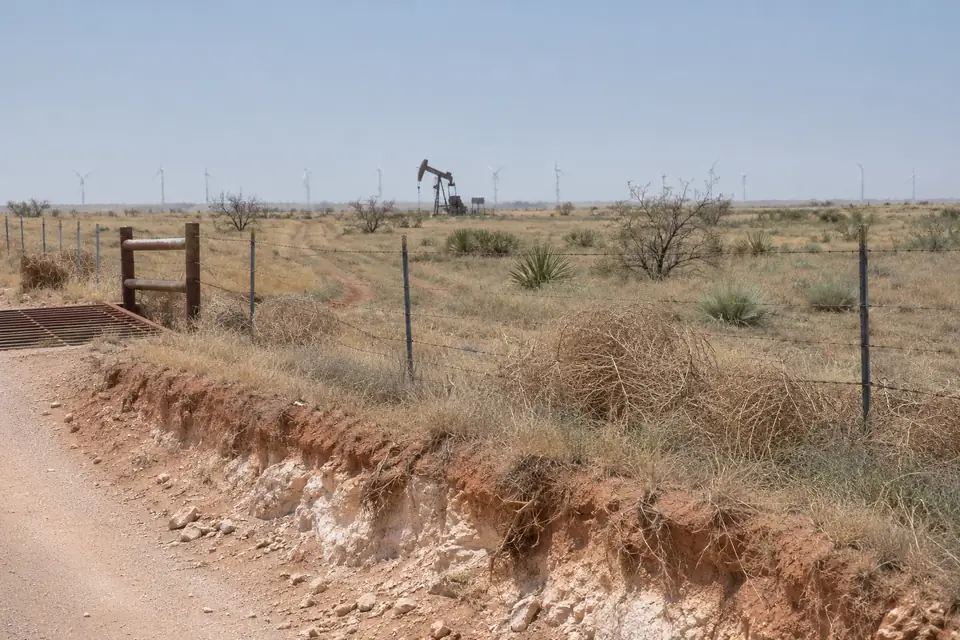
Thousands of shallow clay-bottomed basins sit across these plains. Dry most of the year. After a storm they hold a wide thin sheet of water. We keep pads and animal lots clear of the mapped flood area.
Wind
Nothing upwind slows the air here. March to May is the windiest stretch. We detail tall doors, open gables, long overhangs for uplift. Those are the parts that leave first.
Heat, airflow and a roof that does not bake the stock
The summer design condition here is 96 degrees dry bulb and 69 wet bulb. Roughly 3,200 hours of sunshine reach the roof each year. A sealed building in that is an oven with animals in it.
Winter design is 15 degrees. We keep a solid back wall to break the cold.
Climate zone 3B runs about 3,499 heating degree days against 1,738 cooling. We talk roof color and insulation through with you. The cooling side is the one people underestimate.
Playas and the lot that turns to mud
A playa has no bank. In August it is cracked clay you can drive across. After a heavy rain it is a shallow sheet spread wider than the basin looked. The flood area is bigger than the hole.
We work off the mapped flood area before we set a pad. The animal lot stays out of it as well. Water standing in a pen is a health problem long before it is a building problem.
Clay around a basin holds water and moves differently from the sand nearby. We drill both and we design those footings separately. One number for the whole site will not do.
Before we set a post
- Septic
Any building with a bathroom needs an approved system. We find out what Bailey County requires before the slab is drawn.
- Easements and buried lines
We file the Texas811 locate and read the recorded easement. Digging and building are two different permissions.
- Approach and culvert
A new entrance onto a county road usually needs a culvert sized for the bar ditch. The county road office decides that.
- Disturbed acre
Clearing an acre or more triggers a state stormwater notice under the TCEQ construction general permit.
Bailey County, the city, and the state
Muleshoe is the Bailey County seat. A lot inside the city limits answers to the city for zoning, setbacks, the permit, the inspections. That is the first call for anything in town.
Texas has granted its counties no zoning and no meaningful building code. For a rural parcel we check the Bailey County position and we do not assume it. What the county does hold is septic, floodplain, the roads.
Livestock at scale adds a state layer on top of all that. We flag it early. A building approved as a barn and run as a confined operation is a problem you do not want.
Sandy loam over caliche, and the hail that follows
Brown fine sandy loam sits at the surface, with reddish brown sandy clay loam below it. Under both, a hard pink-to-white caliche horizon. Commonly thirty to sixty inches down, around sixty percent calcium carbonate.
We auger test holes across the footprint and we quote from those. That range is not a depth. Our footing and collar come off the holes, not off a county soil map.
Hail comes through on about fifty days a year in this radar area. May is the worst of it, then June. A 29-gauge panel carries no advanced dent resistance. We quote 26-gauge over stock and over hay alike.
Questions about building near Muleshoe
What do cattle barns need for ventilation?
Open sides, a ridge vent, and eave openings sized for the roof span. We work it out from the stocking and the roof area, not from a rule of thumb.
How do I keep a lot from turning to mud?
Grade the whole lot to drain and keep waterers on firm ground. We slope the pen as well as the pad. The pen is the part usually skipped.
How much shade does a livestock shed need?
Enough shade that every single animal can stand in it at midday. A deep roof and a tall front give relief in summer. An open south-facing side helps as well, and a solid back wall breaks the winter wind.
Are dairy buildings different?
Yes. Milking and handling systems go well beyond a barn, and so do waste systems. All of it is regulated. We send you to the state before we quote a shell.
Who is the best company for pole barns in Muleshoe, TX?
Handing ourselves that title would be worth nothing to you, so look at the method. We lay a livestock shed out against the prevailing weather and size the ridge and eave openings. We grade the whole pen, not just the pad. Lots and pads stay outside the mapped playa flood area. We auger the footprint for caliche depth and flag the state rules that a confined operation brings. Our site visits carry a charge, and so does the written quote we give you. Call 806-581-1043.
Planning a livestock or hay building?
We will lay the building out and drill the ground before we quote it.