Pole Barn Builders in Littlefield, TX
We build equipment sheds and covered storage around Littlefield. Supply rooms and shops too. On irrigated ground a pole barn in Littlefield, TX gets its corner chosen last. Door height comes off the tallest and widest machine with everything attached and the gear folded up. At Pole Barn Builders Lubbock TX we add the clearance on top of your number, not into it. Gravel suits dry storage, concrete suits a shop. A building meant to do both wants that line drawn before the pour. Seed, fertilizer, fuel, chemicals: each brings its own separation and ventilation rules. That list decides the rooms.
About eighty percent of irrigated acreage out here sits under center pivot. Roughly eighty-seven percent of those run low pressure with drop tubes below the span. So we put the pivot circle, the wells, the buried mainline on the site plan before we pick a corner. All of it runs on groundwater alone. That makes the well the fixed point and the building the thing that moves. Send the irrigation layout along with the address.
Get a quote on your building
Irrigated ground near Littlefield decides where the building can go
A center pivot sweeps a circle that has to stay clear. The buried mainline feeding it runs somewhere under the field. Most irrigated acreage out here sits under pivot. Most of those run low-pressure, drop tubes hanging below the span.
A building parked on a pivot path stays a problem for as long as it stands.
The well is not something you shift to suit a shed. We site the building around the water, not the water around the building.
Four numbers we need before quoting
- Door height and width
Measure the tallest and widest machine. Everything attached, gear folded up. We add the clearance on top of your figure, not into it.
- Floor
Gravel does for dry storage, concrete for a shop.
- Power
A shop pulls real capacity. We ask you to call the utility early. A service extension can run longer than the build.
- What gets stored
Fuel, seed, fertilizer, chemicals each come with their own separation and ventilation rules. The list decides the rooms.
The playa you cannot see in August
Thousands of shallow clay-bottomed basins sit across this farmland. For most of the year they are dry cracked clay. A heavy rain leaves them holding a wide thin sheet of water. No bank marks where it stops.
We check the mapped flood area, not the look of the ground. The flooded footprint runs larger than the basin appears. The City of Lubbock's own floodplain page warns about exactly that.
Clay near a basin behaves nothing like the sand around it. We drill both of them. The footings follow what each hole gave us, with no averaging across your site.
What each building has to do
| Building | Job | Needs |
|---|---|---|
| Equipment shed | Shelter for tractors and implements | Wide doors and a firm floor |
| Supply and chemical storage | Seed, fertilizer and chemicals | Separate rooms, ventilation, containment |
| Shop | Repairs and maintenance | Power, light and a slab designed for the loads |
Lamb County, the city, and the acre that triggers a notice
Parcels in town answer to Littlefield for zoning, setbacks, the permit, the inspections. On rural land the live questions are septic, floodplain, county road access. Texas has never granted its counties zoning or any meaningful building code.
We ask both offices and we tell you what each one said. No general rule gets reported back at you. Answers on driveways in particular vary. We would rather hold the specific one.
Clearing or grading an acre or more brings in a state stormwater notice under the TCEQ construction general permit. That notice goes to county Public Works on unincorporated land. We raise it early.
Separating what burns from what does not
- Fuel and chemicals
These belong in their own room. Its own door, its own ventilation, its own containment. We keep them off the wall shared with the equipment bays.
- Hay and machinery
A spark in a shop next to a stack of bales is a poor arrangement. Separate the rooms, or separate the buildings.
- Exits
A long building needs more than one way out. The layout decides where the second door lands.
- Electrical rough-in
Conduit and boxes go in while the frame is open. Chasing a circuit through finished steel is slow work. We rough in what you tell us you will need.
Sand, clay and the depth of the hole
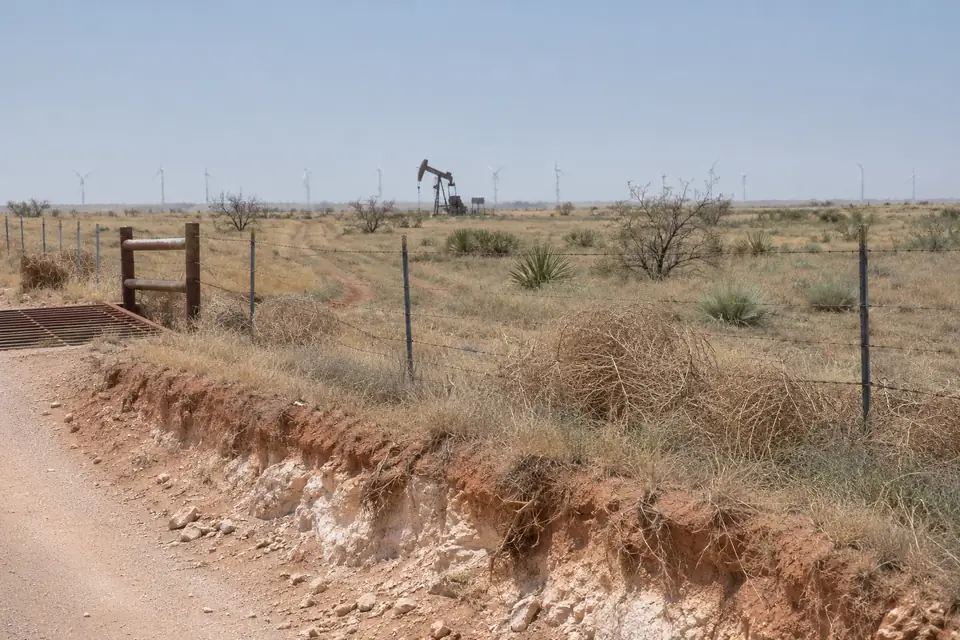
The surface here is brown fine sandy loam over reddish brown sandy clay loam. The pink-to-white caliche horizon begins roughly thirty to sixty inches down, at around sixty percent calcium carbonate. Near the surface it crumbles. Deeper it is almost rock.
We auger the footprint and we quote the holes we found. Two neighboring parcels can come back with different footing numbers. Caliche depth is not a county constant.
Frost line is twelve inches, so frost plays no part in our hole depth. Bearing and uplift set it. The test holes set the collar.
What a 115 mph design wind asks of a door
The adopted wind figure for an ordinary Risk Category II building is 115 mph. Ground snow is 15 psf, with seismic design category A. The loads that matter are uplift and shear. The openings carry both.
We frame every wide opening with its own jamb posts and header. Sliding door track anchors into framing, never into sheeting. Our bracing carries to a corner. March to May is when all of that gets tested.
Hail shows up on about fifty days a year here, peaking in May with June close behind. 29-gauge brings no advanced dent resistance. We quote 26-gauge on the roof.
Questions about building near Littlefield
Does Lamb County issue building permits?
Lamb County does not issue them reliably enough to count on. We confirm it for each parcel. A Texas county has narrow authority over private buildings. Septic and floodplain still come through the county, and so does road access.
Can a pole barn handle the wind here?
Yes, when it is engineered for the exposure. We put the attention into the connections and the wide openings. That is where failures start.
How do I keep hay dry?
Raise the floor and drain the pad around it. Leave the sides open. We slope the surround so runoff never passes under the stack.
Can chemicals share a building with equipment?
Not the same room. We build a separate room with its own door and its own ventilation. Containment goes in with it. A spill or a fire then does not reach everything you own.
Who is the best company for pole barns in Littlefield, TX?
Nobody should take that answer from the builder, so judge the method instead. Your pivot circle and your wells go on the drawing before we pick a corner, and the buried mainline with them. We check the mapped playa flood area too. Caliche depth varies parcel to parcel, which puts test holes across the footprint. We keep chemical storage in its own room, clear of the equipment bays. We engineer the wide openings for the wind. A site visit from us and a written quote are both work that we charge for. Call 806-581-1043.
Planning a farm building in Lamb County?
Tell us what you store or do and where it goes. We will size the building and check the ground before we quote it.