Pole Barn Builders in Floydada, TX
We build pole barns in Floydada, TX in two different situations, and the quote follows which one you have. West and north of town it is flat irrigated cropland, where the job is drainage and wind. East toward the caprock the ground is broken. There it becomes a bench, an access road, whatever the auger hits. Hay barns, equipment sheds, shops: that covers most of it. At Pole Barn Builders Lubbock TX we size a hay barn around your bale and your loader. A shed comes off the tallest machine with its gear folded up.
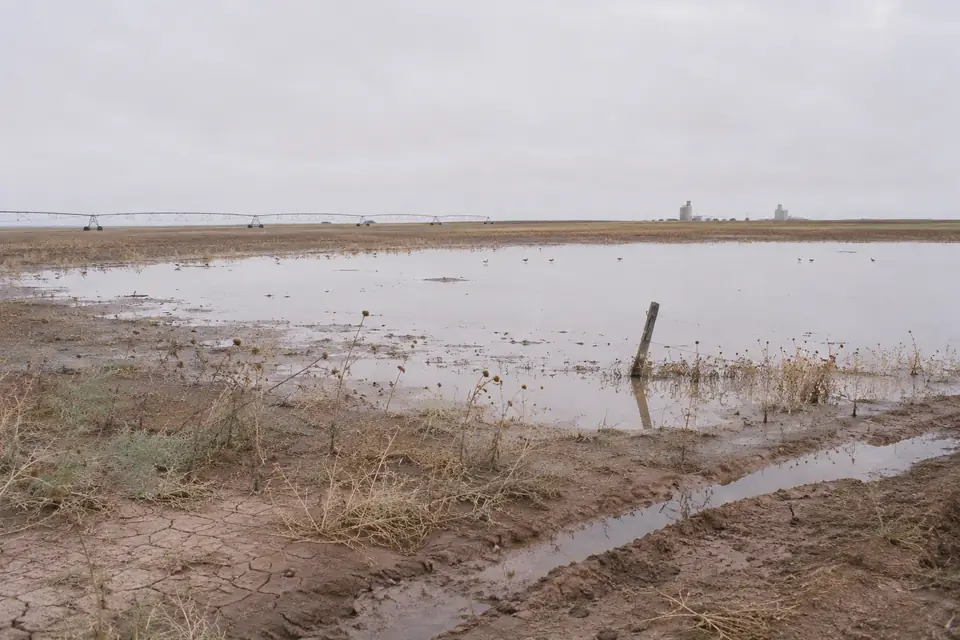
Playa basins sit across this farmland in their thousands. Dry cracked clay most of the year. After a heavy rain, a wide thin sheet of water with no bank. We work from the mapped flood area, not from how your ground looks in August. A hundred-year hour here delivers 3.3 inches of rain. We size the roof drainage and grading off that figure. Tell us the use and where on the property it goes. We will plan the pad from there.
Get a quote on your building
Start with the drainage on a Floydada site
A playa's flooded area reaches further than the basin looks.
We check the mapped flood area before we pick a corner for the building. We walk your ground after rain where the timing allows. A pad that ponds twice a year is a pad you will be fixing for twenty.
Rainfall here runs about eighteen inches a year across roughly sixty-three days. May and June are the wettest. A hundred-year hour delivers 3.3 inches.
What we plan around on Floyd County land
- Flat farmland
Keep off the basins. Raise the pad. Throw roof water away from the low ground. We grade the surround, not just the footprint.
- Broken ground east of town
Draws carry water fast after a storm. A level bench above the drainage beats a sheltered spot in the bottom every time.
- Hay storage
Bales want a dry floor and air moving through. We raise the floor and leave the sides open where the use allows.
- Equipment sheds
Door height comes off your tallest machine with the attachments up, plus clearance for a crosswind.
Flat farmland west, broken ground east
West and north of Floydada the ground is flat irrigated cropland. East, the plains begin to break toward the caprock. Slope, draws, rock. All three arrive within a few miles.
We quote those two differently. A flat site is a drainage and wind problem. A broken site is a bench problem, an access problem and a rock problem. Tell us which side you are on and we will tell you what changes.
Irrigation sets the rest of the layout on the flat side. Center pivots sweep a wide circle. Buried pipe crosses the field. We draw both on the plan before we put a building anywhere near them.
Picking the bench on rolling ground
- Find the firm, drained shelf
A level bench above the drainage gives you firm ground. Runoff leaves the pad. No flood path runs through the building.
- Stay out of the draw
A draw looks sheltered and takes the water. Dry ninety-nine days out of a hundred is not the test.
- Expect rock
Hard layers slow the excavation right down. We drill test holes on the bench before we price footings or a cut.
- Fix the approach first
We often grade the approach before anything else. Steep or washed-out ground stops a concrete truck cold. A short dozer job beats a lost pour.
Who you call, inside town and out
Floydada, inside the limits
Floydada is the county seat. A lot in town answers to the city for zoning, setbacks, the building permit and the inspections. City hall is the first call.
Floyd County, outside them
Texas has never granted counties zoning or any meaningful building code. On a rural parcel the live questions are septic and floodplain, plus county road access. We ask the county and we tell you exactly what they said.
Hay that stays dry and does not cook
Bales take up water from below as readily as from above. A raised and drained floor does more for the stack than another foot of eave height. So do open sides.
We slope the ground away from all four walls and keep roof runoff off the pad. The ridge and the eaves stay open enough for air to move. Hay that stays warm is hay that can light.
Distance is cheap insurance. A hay barn belongs well clear of the house, the shop, the fuel. A bale fire is not one you put out with a hose.
Caliche, sand and what the auger finds
Your surface here is most likely a brown fine sandy loam over reddish brown sandy clay loam. Under that sits a hard pink-to-white caliche horizon. It begins somewhere around thirty to sixty inches down, at about sixty percent calcium carbonate.
We auger test holes across the footprint, not one in the middle. The depth shifts inside a single field. What we find sets the footing and the collar. It sets the equipment we bring out.
Clay turns up near the drainage and around the basins. It behaves nothing like the sand. We treat those footings separately and we do not average your site.
Wind, hail and the roof you put on
Design wind for an ordinary Risk Category II building is 115 mph here. Ground snow sits at 15 psf. Seismic design category is A. Uplift and shear are the loads that decide your frame.
About fifty hail days a year cross this radar area. The peak is May, then June. 29-gauge carries no advanced dent resistance. We quote 26-gauge R-panel.
Ag panel suits an open hay barn and wants two and a half in twelve of pitch. R-panel will go down to half an inch in twelve. We match the profile to the pitch, not the pitch to the profile.
Questions about building near Floydada
Do I need a permit near Floydada?
Inside the city, ask city hall. Outside it we confirm with Floyd County, because what a Texas county can require of a private building is narrow.
Can I build on sloping ground?
Yes. We cut a level bench and drain it on all four sides. The footings come off test holes, not off the slope.
What suits a small hay operation?
Open-sided barn on a raised, drained floor. We size the bays from your bale size and from your loader.
Can hay barns sit on sloped ground?
Yes. That means a level pad and drainage that carries the water around, not under. We never let runoff pass beneath the bales.
Who is the best company for pole barns in Floydada, TX?
Not a question we can honestly answer about ourselves, so here is the method. Hail is why we quote 26-gauge. We check the mapped playa flood area before choosing a corner. Test holes go across the footprint. Caliche depth moves inside one field. On the broken ground east of town we cut and drain a level bench. We confirm with the city or Floyd County who actually regulates your parcel. We bill for the site visit and quote. Call 806-581-1043.
Have land in Floyd County?
We will plan the pad and drill the ground before we quote it.