Soil and Foundations for Pole Barns in Lubbock and the South Plains
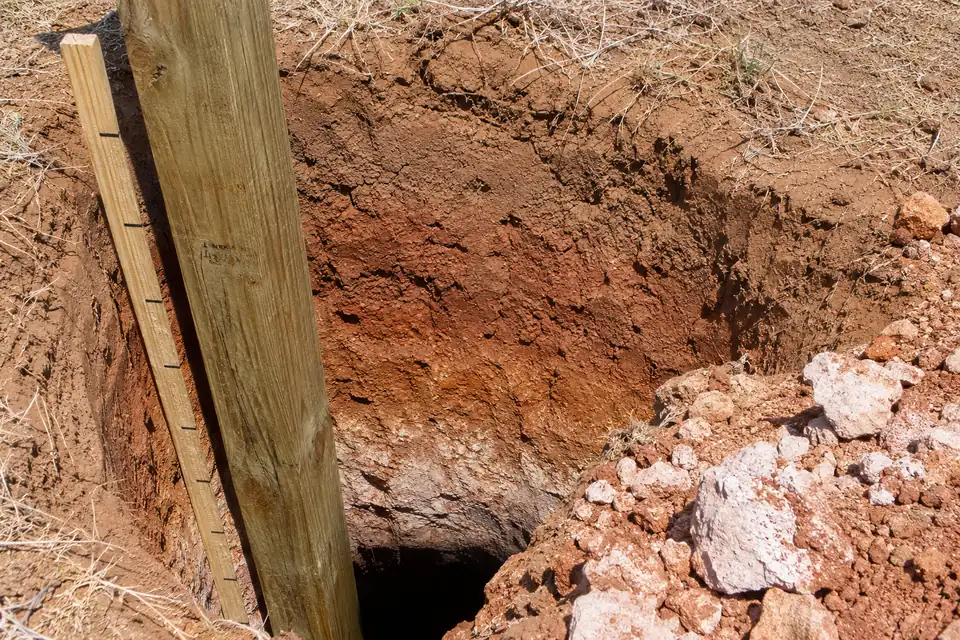
We plan soil and foundations for pole barns in Lubbock and the South Plains off what comes out of the test hole. A standard detail is not where we start. The dominant local ground is the Amarillo series. Brown fine sandy loam at the surface, reddish brown sandy clay loam beneath it, then yellowish red. Then a hard pink-to-white caliche horizon, beginning roughly thirty to sixty inches down and running around 60 percent calcium carbonate.
Caliche is crumbly near the surface and close to rock-hard at depth. That changes what augering a hole takes, and what the footing bears once it is in. Playa clay is the opposite trouble, swelling wet and cracking dry. The City of Lubbock's floodplain guidance warns that a playa floods over an area larger than the dry basin looks. We keep pads and posts clear of it. Adopted frost line depth here is 12 inches, nowhere near the depth we actually set posts to. Anybody about to mix concrete should know what sits under the whole footprint, not under one corner.
Get a quote on your building
Three kinds of ground, sometimes under one slab
Most of what we auger through here is the Amarillo series. Brown fine sandy loam at the surface. Reddish brown sandy clay loam under that, then yellowish red. Then a hard pink-to-white caliche horizon, starting somewhere around 30 to 60 inches down and running about 60 percent calcium carbonate. Near a playa the picture changes. Those basins are floored with clay that swells as it takes water, then shrinks and cracks as it dries out. All three can show up on one property. Now and then all three turn up under one building we are setting out.
We check what each hole actually hits. We never price a depth we have not seen with our own eyes. A post-frame building stands on a small number of posts. No single footing carries spare capacity. The ground under the corner post may behave nothing like the ground twelve feet along the same wall. We log every hole as we auger it.
Caliche, loam and playa clay under load
| Ground | Behavior | What changes in the design |
|---|---|---|
| Caliche | Carries load well and fights an auger. | Often good bearing higher up than loam gives. We bring heavier drilling gear and clean the hole bottoms out. |
| Sandy or clay loam | Drains reasonably and carries moderate loads. The sandier types cut away under runoff. | Footing size and depth come off the loads. Grade the site so runoff cannot undercut a post. |
| Playa and other expansive clay | Swells with moisture and shrinks as it dries, opening cracks. | Deeper embedment, drainage settled first, a frame that tolerates movement. We site the building out of the basin. |
Where post depth actually comes from
Embedment depth falls out of the loads, not out of a regional habit. Downward load on each post, uplift when the wind gets under the roof, the sideways push on the walls. Add what the surrounding soil will resist between them. Those four set the figure. A bigger footprint drives it deeper, and so do taller walls and an open front. Firm caliche within reach can bring it back, and expansive clay pushes it down again. The adopted frost line depth here is only 12 inches, so frost is not what governs.
Posts set too shallow stand straight for years. Then they lean after a wet spring or one hard blow. Going deeper at the outset costs a fraction of straightening a building that has already moved. We will argue with you about depth now. A remedy later is the conversation nobody wants.
Where the roof water goes
A barn roof is a big catchment. It empties at a few points. About 18.3 inches a year falls here across roughly 63 days, mostly in short heavy bursts. Where we send that water decides how long your posts last. We work the drainage out with you before we set a single one.
Roof runoff
Send it away from the walls. Water standing at the ground line keeps a post wet exactly where the wood works hardest. The 100-year rainfall intensity here is 3.3 inches an hour. The discharge point has to handle a real flow.
Grade
Fall the ground away on all four sides. Hold the pad above what surrounds it. Fine sandy loam cuts fast under concentrated runoff. A downspout dumping in one spot will undermine a post in a few seasons. We carry our discharge out past the drip line and we tie it into something that can take it.
Ask these before concrete goes in
- What was found at the bottom of each hole?
We do not pour a hole just because it is already dug. When one of ours has to change, we say so. Anything bottoming out in soft or filled ground goes deeper or wider first.
- What depth and collar size does the engineer specify?
Both numbers sit on the structural drawings. What goes in the ground should match them exactly.
- Is a soil test warranted?
On a larger or heavier building, get a geotechnical report. The same goes for any site with known clay. It costs a great deal less than correcting a foundation that has already moved.
- Where is the flood map line?
A playa's flood area reaches past the dip you can see. The water spreads as a wide thin sheet with no defined bank. We pull the map ourselves before anybody picks a spot with us.
Pouring a slab in West Texas heat
We treat curing as part of our pour. The summer design temperature here is 96 degrees dry bulb. The wind runs hardest from March through May. Fresh concrete gives up its water faster than most people expect. We wet the base. We get a curing compound on. We stay off the hottest hours of the day. Underneath all that a slab still wants a firm compacted base. Reinforcement gets matched to whatever will roll across it. Joints get set so the cracking happens where it was planned. On clay, holding the moisture steady at the slab edge is what keeps the thing flat.
Ground questions we get
How deep do the posts go?
As deep as the loads and the soil require. That number comes off the drawings, not off a regional standard. Tall walls and an open front push it down, and so does expansive clay. Firm caliche within reach can pull it back.
Is caliche good or bad to build on?
Good, mostly. It is cemented and dense, so it bears well, and at depth it runs close to rock-hard. We bring heavier drilling gear to a site where it comes up shallow. We allow for that in what we quote. It is also the material under most of the drives we run on out here.
Why are playas a problem for buildings?
Three reasons. They flood after heavy rain. The water spreads wider than the visible low spot, because there is no defined bank. The clay under them swells and shrinks through the year. The City of Lubbock flags exactly that spread in its floodplain guidance, a warning we take seriously. We walk the low ground with you before we commit our footprint to it.
Can I build on a site with mixed soils?
Yes, and most sites we work on are mixed. We design the footings for what each hole turns up, not for an average of the property. Our depths can vary across one wall.
Do I need a soil report?
Not always. A small shed on ground already known to be firm usually does not call for one. A large or heavy building is worth testing before we commit to a footing design. So is anything close to a playa. Guessing at it is not how we set a footing depth; we tell you when a report is needed.
Back to the homepage
Ground conditions are one input of several. The homepage shows the range Pole Barn Builders Lubbock TX builds across the South Plains. That is the place to open a project.
Have the ground looked at first
Send the location and what the building has to hold. Our footing plan then follows what is under that particular patch of ground. We tell you what we find in the holes as we go.